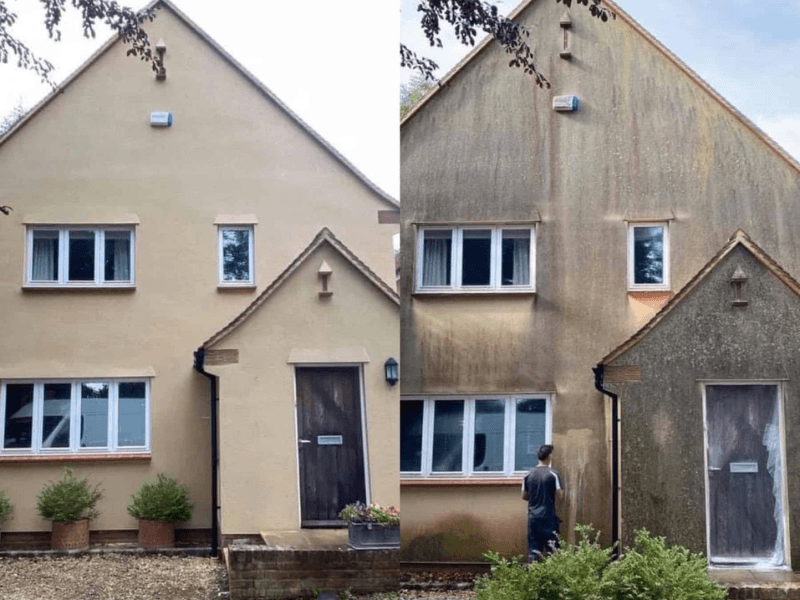
It surprises people that a house barely three years old can look greener than the 1930s semi down the road. It is not a build fault. It is usually exposure.
Why it happens so fast
New estates are open. There are no mature trees and no established rows to break the wind, so wind-driven rain hits the same elevation again and again and the north and east walls stay damp for longer. Algae needs damp and light, and a smooth pale render gives it both. On top of that, first-year gutters often hold builder's debris and mortar droppings, and paving joints are still settling and losing sand.
Check the warranty before you pay anybody
If the house is still inside its builder's snagging period or its structural warranty, defects are their job, not yours. Staining from a blocked or badly fitted gutter is a defect. Algae on a wall that faces the weather is not. It costs you one email to ask before you spend anything, and worth doing in that order.
Render: soft wash, never pressure
Modern silicone and acrylic renders are thin coatings over insulation or board. A pressure washer will mark them, and on a bad day it will drive water behind them. Soft washing from £6/m² uses a treatment that kills the growth and lets it weather off, with no force on the surface. Anybody offering to jet-wash your render is telling you what they own rather than what your house needs.
Gutters in the first years
Worth a look after the estate finishes building rather than on a fixed annual cycle. Mortar, plastic offcuts and sand find their way in during construction, and they do not wash through. Clearance starts at £85.
Block paving: sand, not sealer, to start with
New paving needs its joints kept full more than it needs sealing. Most sealers want the surface to have weathered a season first, so the usual order is clean, re-sand, then seal later if you want it. Sealing too early traps what is underneath.
Ready to sort yours?
Send photos of the elevation