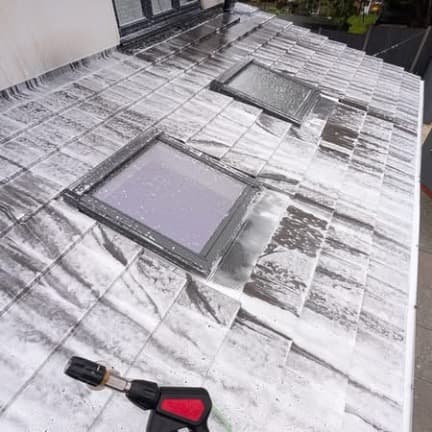
Walk down almost any street in Northamptonshire and look up. On a lot of houses one pitch is fairly clean and the other is green, and on a terrace the same side is green all the way along. It is not one roof being neglected. The green side is nearly always the side facing north, and once you know why, you can read your own roof from the garden.
Moss needs two things: water and time
Moss, algae and lichen do not eat the tiles. What they need is a surface that stays damp for long enough, often enough, for spores to settle and take hold. Every roof gets the same rain. What differs is how quickly each pitch dries afterwards, and that comes down almost entirely to sunlight.
In the UK the sun sits in the southern half of the sky. A south-facing pitch catches it for most of the day, so dew burns off early and rain dries off within hours. A north-facing pitch is angled away from it. Through the winter months, when the sun is low, a north pitch can get little or no direct sun at all. Dew sits on it into the afternoon, rain stays in the tile texture for days, and the pitch rarely gets the chance to dry out properly between one wet spell and the next. That is exactly the condition moss is waiting for.
Why east is next, and west is usually better
East-facing pitches get the sun early, when it is weakest and the tiles are at their wettest from the night, then lose it before it has any warmth. West-facing pitches catch the warmer afternoon sun, so they usually dry better. That is why, after the north side, the east side is the one James most often sees with a green tinge creeping in from the bottom edge.
What makes a north pitch even worse
- Trees and taller neighbours. Either can put a pitch into shade, and an overhanging tree drops leaves and needles that hold water against the tiles like a sponge.
- Older concrete tiles. As concrete tiles age the surface roughens and becomes more porous, so it holds water longer and gives spores more to grip onto than smooth clay, slate or newer concrete.
- A shallow pitch. Water and debris run off a steep roof quickly. A shallow one, such as a porch, a single-storey extension or a dormer, holds them longer.
- Blocked gutters. A gutter full of silt keeps the bottom course of tiles permanently damp, which is why moss so often starts along the eaves and works upwards.
It is not only the roof
The same rule applies to everything else on the north side of the house. North-facing render goes green for the same reason the north pitch does, which is why so many enquiries for render cleaning are for one wall rather than the whole house. Fascias and soffits on the shaded side pick up algae first, and the patio or path tucked along the back wall is usually the one with the moss and black spot. If your north pitch is green, it is worth looking at the wall and the ground beneath it too.
Does the moss do any harm?
A thin film of algae is mostly a looks problem. Established moss is different. It holds water against the tiles, and as it grows it can lift tile edges and fill the gaps where tiles overlap. Every heavy shower then washes clumps of it into the gutter, which is the pattern covered in our guide on roof moss blocking gutters. If you are clearing the same gutter run on the north side every year, the roof above it is where the problem actually is.
How Whales treats a roof with one bad side
Because moss grows from the root, knocking it off the surface only buys a season. Whales’ roof cleaning combines manual moss scraping to take the bulk off, a hot-water, low-pressure clean, and a BAC 50 biocide treatment that kills what is left at the root. A roof is never jet washed, because high pressure strips the tile surface and pushes water where it should not go. James checks the tile type and condition before settling the method, because what is right on clay is not always right on older concrete.
Roof cleaning starts from £11/m². The package includes a window clean, a gutter clearance and a house wash, which matters most on exactly this kind of roof: whatever comes off the north pitch ends up in the gutter and down the wall beneath it, and both get cleaned in the same visit.
Will it come back?
On the north side, eventually, yes, because nothing about the cleaning changes which way the roof faces. A treated north pitch stays clean far longer than one that was only scraped, but it will always be the first part of the roof to show a tinge again, usually along the bottom edge or under a tree. That is not the treatment failing. It is the hardest spot on the roof behaving as the hardest spot does, and a light retreat of one pitch costs a fraction of the original job. Our guide on how long a roof clean lasts goes into what decides it.
If you are not sure whether one green pitch needs doing now or can wait, take a photo of each side of the roof from the garden and the street and send them over. James will say which pitches need treating, whether the render or gutters beneath want doing at the same time, and what it costs before anything is booked.
Ready to sort yours?
Send roof photos for a fixed price →