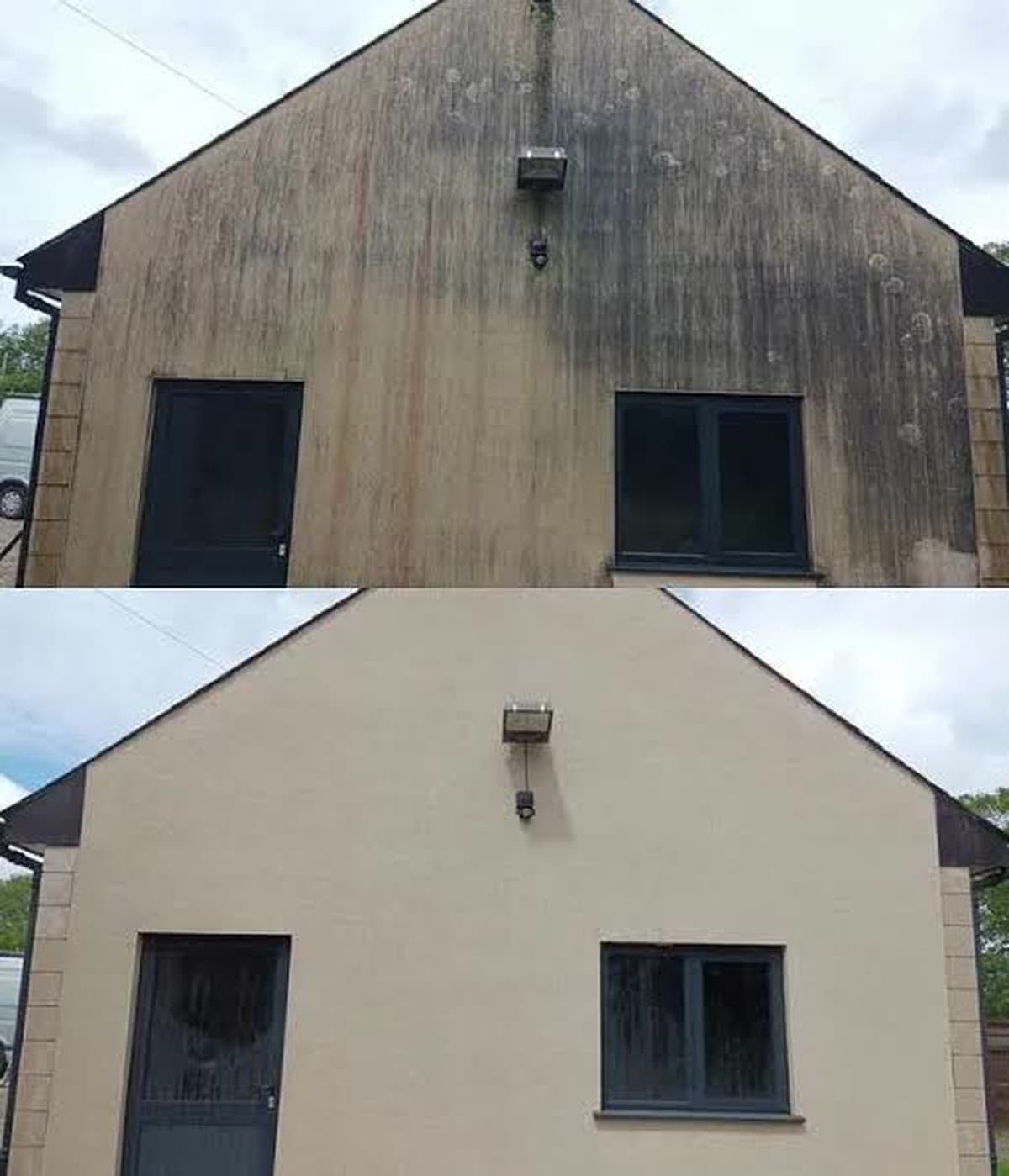
Most people who get in touch ask for the outside of their house to be ‘jet washed’. It is a fair shorthand, but it hides the most important decision on the job. Some surfaces are built to take pressure and clean up best with it. Others are thin, porous or fragile, and pressure is exactly what damages them. For those, the cleaning is done by a treatment that is left to work, with the water only there to rinse. That second approach is soft washing, and knowing which surface needs which is most of what separates a good clean from an expensive repair.
What the two terms actually mean
Pressure washing uses the force of the water to lift dirt, moss and growth off a surface. Done properly on paving, that means a biocide pre-treatment first and a rotary surface cleaner rather than a focused jet, so the pressure is spread evenly and controlled. The chemistry weakens the growth; the pressure takes it away.
Soft washing flips that balance. A treatment goes on at low pressure, is given time to dwell and kill the algae, moss or bio-growth at the root, and is then rinsed gently. Nothing is blasted off. Some of the dead growth rinses away on the day and the rest weathers off over the following weeks. Because it depends on the treatment being given time, soft washing needs suitable weather. It is not an all-weather job, and anybody promising otherwise is planning to rush the dwell time.
Where pressure belongs: driveways and patios
Block paving, concrete and most slabbed patios are made to be walked and driven on. They take a controlled pressure clean well, and pressure is the quickest way to get ingrained dirt out of a textured surface. Driveway cleaning starts from £3.50/m² and patio cleaning from £4/m², and both include the biocide treatment, because pressure on its own knocks off what you can see and leaves the roots behind.
The weak point on paving is not the blocks, it is the joints. Any pressure clean lifts some of the jointing sand along with the moss, which is why Whales always talks about the joints before the job. Re-sanding and sealing is quoted separately, and our guide on whether pressure washing is safe for block paving covers what goes wrong when it is skipped.
Where pressure does damage: render
Render is the clearest case for soft washing. Modern silicone and acrylic renders are thin coatings, often over insulation or board, and older traditional render can be soft and crumbly at the surface. A pressure washer will mark the finish, can drive water in behind it, and on a bad day will take pieces off the wall. Render cleaning starts from £6/m² and is a soft wash throughout: the treatment kills the green algae and lifts the grey atmospheric staining, and the original colour comes back without any force on the wall. If a quote for render mentions a pressure washer, ask what it is for.
Roofs: low pressure, and the right method for the tile
High pressure on a tiled roof strips the surface of the tile and pushes water where it should not go, so a roof is never jet washed. It is not a pure soft wash either. Whales’ roof cleaning, from £11/m², combines manual moss scraping to take the bulk off, a hot-water, low-pressure clean, and a BAC 50 biocide treatment to kill what is left at the root. James checks the tile type and condition before settling the method, because what is right on clay is not always right on older, more porous concrete tiles. The package includes a window clean, gutter clearance and house wash, so the walls and glass that catch the run-off are cleaned too.
Fascias and soffits: treatment and agitation
UPVC fascias and soffits look solid but are easily marked, and there is no need for pressure on them at all. A TFR treatment goes onto the boards and they are agitated to lift out the dirt, algae and growth, then rinsed down. It is the same thinking as render: let the chemistry do the work. Our fascia and soffit guide explains how it differs from clearing the inside of the gutters.
The in-between cases
Two surfaces sit between the two approaches. Natural stone patios, such as Indian sandstone and limestone, can be pressure cleaned, but only at the right pressure for the stone and only after the black spot has been treated. Raw pressure on sandstone opens up the surface and gives lichen more to grip, which is covered in our guide on removing black spots from a patio. Tarmac is the other. It is pressure cleaned as preparation, but grey tarmac is oxidised rather than dirty, so the real work is the restorer that goes on afterwards. Tarmac restoration starts from £11/m².
A quick reference
- Block paving and concrete driveways: controlled pressure, with biocide pre-treatment, then think about the joints.
- Slabbed and concrete patios: controlled pressure, with biocide pre-treatment.
- Natural stone patios: reduced pressure, black spot treated first.
- Render, pebbledash and painted walls: soft wash only.
- Roofs: manual scraping, hot-water low-pressure cleaning and biocide, method chosen after checking the tiles.
- Fascias and soffits: treatment and agitation, no pressure.
- Tarmac: pressure clean to prepare, restorer to bring the colour back.
Three questions to ask whoever quotes
Whoever you use, three questions tell you quickly whether they are matching the method to the surface. What goes on before any water does? How long is it left to work? And will they move the date if the weather turns? A clean that relies on pressure alone has no good answer to the first two, and a soft wash booked regardless of the forecast is being rushed. The easiest way to get a straight answer is to send James two photos of the surface, and he will tell you which method it needs and what it costs before anything is booked.
Ready to sort yours?
Send two photos for a fixed price →